 |
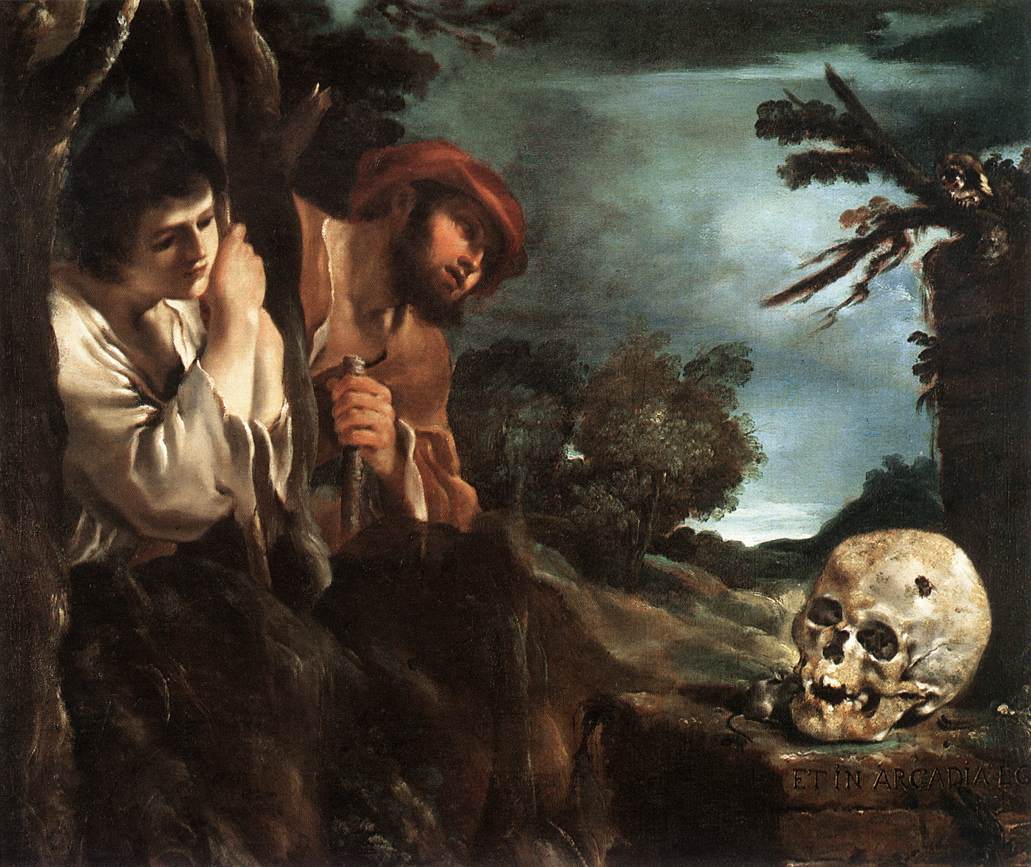
| "Et in Arcadia Ego" by Guercino |
The phrase serves as the title of two separate paintings by Nicolas Poussin. Both are pastoral paintings depicting shepherds from classical antiquity standing alongside a tomb on which the phrase is inscribed. In ancient Greece, Arcadians lived in the middle of the Peloponnese mountains as shepherds and apart from urban life. Arcadia was viewed as a type of utopia which symbolized pure, idyllic life. In Poussin's works, the person buried in the tomb seems to have lived in Arcadia and enjoyed the pleasures of life on earth but is now dead. The paintings may be interpreted as types of "Memento Mori" : Remember your death. There is an ironic contrast between the shadow of death and the typical merriment which the natives of Arcadia were believed to embody.
There is a third painting which also takes "Et in Arcadia Ego" as its title. This one is by the Italian Baroque artist Guercino and depicts two young shepherds looking at a skull, which is placed on a cippus bearing the same engraving as the work's title. This painting serves as the first appearance of the phrase in art and architecture.
The skull in Ryder's room seems to point more towards Guercino's painting. Now, while I have heard of one or two people who had a skull decorating their dorm rooms at Franciscan, this does seem like an odd decoration. But then again, Ryder is also an artist so he's allowed to be eccentric. Regardless, both the title of Book I and the skull serve as ominous warnings, "Remember your death." Perhaps these point to further troubles to come? At the moment, Ryder and Sebastian seem blissful, enjoying each other's company and the many pleasures that life has to offer. Ryder is experiencing the childhood he never had, only with adult toys (drink and the like). They are in Arcadia, but it cannot last. Sebastian's home, Brideshead, also could be seen as a type of Arcadia with all of its beauty and grandeur.
 |
| Sink me! It's Anthony Andrews! |
Well, that's all for now! Keep up the reading and hope to hear from the other writers soon!

Dear Emily, good work on the Art end of things. We looked at that painting in Art Appreciation. I don't remember the period, but it may be Neo-Classical. Then again, it may be earlier. Anyway, you're right, the idea is that death is a reality even in the greatest earthly paradise.
ReplyDelete-EM