Friday, July 13, 2012

Brideshead Revisited: Catholic w/ a Universal Appeal


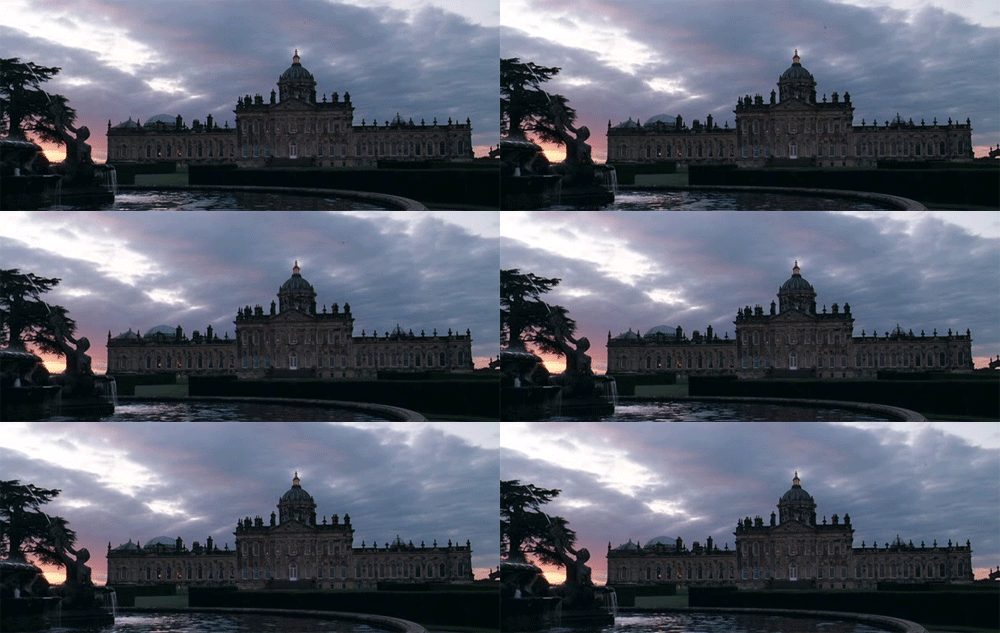
Castle Howard, North Yorkshire
served as the location for filming Brideshead
 in both the miniseries and the 2009 adaption.

Hello all! Hope you have been keeping up with the reading assignments. I'm hoping to post again soon about the title and the beginning of Book II. I absolutely loved the beginning of Book II -- I think that's my favorite literary part. Waugh is so eloquent! By the way, did you know  that Evelyn Waugh described this work as semi-autobiographical, recounting memories from his own years at Oxford? And, another quick fact: Waugh converted to Catholicism in the year 1930 after the failure of his first marriage. AND, don't you adore the place they used for the house? (In the words of Scott and Matthew, "That's MY house.")

Well, I recently posted on my other blog with some reflections on the book, so I thought I would repost it here for your enjoyment. It serves chiefly as an answer to the question as to why the book, in spite of its Catholic themes, has an appeal to such a broad audience.


Though Catholicism serves as one of the central themes of the story, it appeals to people of all beliefs (as evidenced by the fact that it is in top 100 lists of secular publications). For example, Waugh is one of the favorite authors of Fr. Robert Barron, a Catholic priest well known for his work in the "Catholicism" series, as well as the recently deceased British atheist, Christopher Hitchens. Why does a universal audience appreciate this novel when many non-Christians reject so many Christian stories? First of all, it is a well-crafted piece of literature! The writing style and the descriptions are beautiful, elegant, and poetic. Good art -- in this case, good writing -- appeals to a universal audience, regardless of background and belief. You can be a Budhist, an atheist, or a Catholic and still find the Sistine Chapel inspiring! In this case, we are dealing with literature not painting, but the truth still stands. As a quick example, I'm including a passage from the beginning of Book II:

"The human soul enjoys these rare, classic periods, but, apart from them, we are seldom single or unique; we keep company in this world with a hoard of abstractions and reflections and counterfeits of ourselves -- the sensual man, the economic man, the man of reason, the beast, the machine, and the sleep-walker, and heaven knows what besides, all in our own image, indistinguishable from ourselves to the outward eye. We get borne along, out of sight in the press, unresisting, till we get the chance to drop behind unnoticed, or dodge down a side street, pause, breathe freely and take our bearings, or to push ahead, outdistance our shadows, lead them a dance, so when at length they catch up with us, they look at one another askance, knowing we have a secret we shall never share."

Secondly the story itself is appealing to a broad audience with its high stakes and universal themes of love, friendship, betrayal, and spirituality. Thirdly, the view of Catholicism is coming from an outsider's perspective: Ryder is an agnostic raised without any religion. I think perhaps this may make the story more approachable for non-Christians. In addition, the portrayal of Catholicism is both enigmatic and controversial. I would hardly call it a favorable portrayal of Catholicism. Most of the characters who identify themselves as Catholic are seriously flawed. 
And yet, it is called one of the most Catholic novels of the 20th century. I have yet to understand why, but I am hoping it will become apparent by the novel's conclusion. 
We are currently nearly into Book II. I have also been watching BBC's miniseries adaption of the novel as I read. Though there have been a few unnecessary butt shots and there is a sex scene in need of skipping, the series is a commendable adaption of Waugh's masterpiece thus far! One of its greatest strengths is its faithfulness to Waugh's beautiful words. It also contains some excellent acting from Anthony Andrews and Jeremy Irons. If you are looking for some quality entertainment and food for thought before summer's end, I highly recommend Brideshead Revisited
And for all you soundtrack buffs, I've read reviews of the newer film that came out in 2008 and, while it's not as accurate and probably not as good, it does have a beautiful soundtrack! It's a similar style to the recent adaption of Pride and Prejudice and Finding Neverland.

Tuesday, July 3, 2012

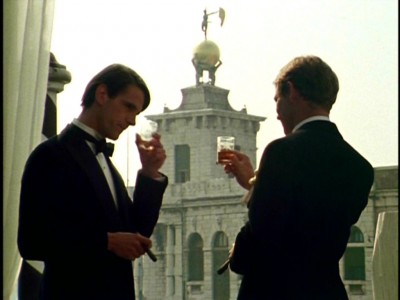
Study Questions and Two Portraits

So I found a series of study questions from a previous reading of Brideshead Revisited, so I thought I'd share! I decided to do a bit of answering for question #3, specifically Charles and Sebastian. Almost to Book II, y'all!


1. Each character represents a prototype of certain attitudes towards religion. Understanding these roles helps us understand the tensions between the different characters. What type of person does each of the following characters represent? If any characters not on this list stood out to you then please share your thoughts.
--
A. Charles Ryder --   Charles, as an agnostic, offers a fresh perspective on Catholicism with which cradle-Catholics are unfamiliar. For most of the book he has acted as only an observer, a spectator on first the life of Sebastian and eventually on his whole family. He observes Sebastian's "Catholicism" or lack thereof, and the "Catholicism" of his family. The Catholicism of the Flyte family is particularly multifaceted with devotees and rebels, and Charles takes not of this.  He has merely observed for most of Book I. The most decisive act he has taken thus far was when he gave Sebastian a few pounds so he could slip off to the pub at the hunt during Christmas holiday. He was clearly disobeying the wishes of Lady Marchmain and siding with Sebastian, though I can't help feeling that until that point he was trying to play "nice" to both parties: Sebastian and his family. But it is here that he expresses his disapproval of Lady Marchmain's methods (and while I disagree with his method of disapproval, he's right in that Lady Marchmain's methods are clearly adding fuel to the fire rather than putting it out). I felt it keenly when he told Bridey that Sebastian may have had a chance at a happy, healthy life had it not been for religion. Perhaps this is true. The Catholicism which the Flyte family practices, with which Lady Marchmain has brought up her family, has certainly set up at least two of her children for disaster -- who knows what will become of Cordelia. Even Bridey himself doesn't seem entirely human to me, but I'll talk about him in a little bit. 


B. Sebastian -- Six words: "Make me virtuous but not yet." He believes in Catholic teachings "because they are a lovely idea." When Charles dismisses it as nonsense, Sebastian asks, " Is it nonsense? I wish it were. It sometimes sounds terribly sensible to me." (Which makes me wonder, is it a valid reason to believe something because it is a lovely idea? Unicorns are quite a lovely idea, but does that mean you can believe in it? Food for thought...) He believes, but he believes that one cannot be both Catholic and happy, which is positively dreadful, though I can see how people can arrive at such a conclusion. I wonder what his upbringing was like so that he came out in such a way? Such a tragedy. I still can't figure out why he was driven to drinking. His family, mostly his mother, obviously instigate it immensely, but I can't figure out why. Cordelia may hold a possible key. Just before Book II she tells Charles, "I used to thin Sebastian had [a vocation] and hated it--but I don't know now." He's obviously avoiding/running away from something, or perhaps many things.

C. Julia -- 

D. Lady Marchmain -- 

E. Lord Marchmain -- 

F. Rex Mottram -- 

G. Nanny Hawkins -- 

H. Cordelia --

I. Bridey --

2. While this book has certain themes that are undeniably Catholic, it appeals to people of all beliefs (the fact that it is on top 100 lists of secular publications is evidence for this). Why do you think a universal audience accepts and appreciates this novel when non-Christians reject so many Christian books, movies, etc.? What sets it apart?

3. Every single one of the characters displays virtues and major flaws, even the ones that are considered devout. Does the existence of major flaws in characters who identify themselves as Catholic enhance or detract from the overall impact of the book? Why?

4. Do you think that this novel presents an appealing view of Catholicism? Why or why not?

5. It would be a shame to read this book without noticing the beauty of Waugh’s writing, and drawing the connection between the beauty of his style and the message within. What sentence or paragraph most stood out to you as a snapshot of both Waugh’s skill as an artist and the tone or theme of the book?