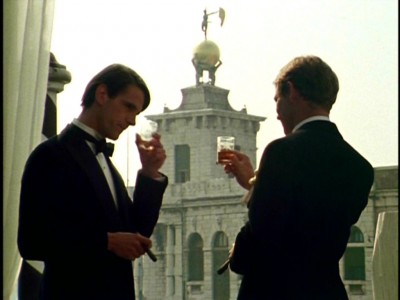
 So I found a series of study questions from a previous reading of Brideshead Revisited, so I thought I'd share! I decided to do a bit of answering for question #3, specifically Charles and Sebastian. Almost to Book II, y'all!
1. Each character represents a prototype of certain attitudes towards religion. Understanding these roles helps us understand the tensions between the different characters. What type of person does each of the following characters represent? If any characters not on this list stood out to you then please share your thoughts.
--
A. Charles Ryder -- Charles, as an agnostic, offers a fresh perspective on Catholicism with which cradle-Catholics are unfamiliar. For most of the book he has acted as only an observer, a spectator on first the life of Sebastian and eventually on his whole family. He observes Sebastian's "Catholicism" or lack thereof, and the "Catholicism" of his family. The Catholicism of the Flyte family is particularly multifaceted with devotees and rebels, and Charles takes not of this. He has merely observed for most of Book I. The most decisive act he has taken thus far was when he gave Sebastian a few pounds so he could slip off to the pub at the hunt during Christmas holiday. He was clearly disobeying the wishes of Lady Marchmain and siding with Sebastian, though I can't help feeling that until that point he was trying to play "nice" to both parties: Sebastian and his family. But it is here that he expresses his disapproval of Lady Marchmain's methods (and while I disagree with his method of disapproval, he's right in that Lady Marchmain's methods are clearly adding fuel to the fire rather than putting it out). I felt it keenly when he told Bridey that Sebastian may have had a chance at a happy, healthy life had it not been for religion. Perhaps this is true. The Catholicism which the Flyte family practices, with which Lady Marchmain has brought up her family, has certainly set up at least two of her children for disaster -- who knows what will become of Cordelia. Even Bridey himself doesn't seem entirely human to me, but I'll talk about him in a little bit.

B. Sebastian -- Six words: "Make me virtuous but not yet." He believes in Catholic teachings "because they are a lovely idea." When Charles dismisses it as nonsense, Sebastian asks, " Is it nonsense? I wish it were. It sometimes sounds terribly sensible to me." (Which makes me wonder, is it a valid reason to believe something because it is a lovely idea? Unicorns are quite a lovely idea, but does that mean you can believe in it? Food for thought...) He believes, but he believes that one cannot be both Catholic and happy, which is positively dreadful, though I can see how people can arrive at such a conclusion. I wonder what his upbringing was like so that he came out in such a way? Such a tragedy. I still can't figure out why he was driven to drinking. His family, mostly his mother, obviously instigate it immensely, but I can't figure out why. Cordelia may hold a possible key. Just before Book II she tells Charles, "I used to thin Sebastian had [a vocation] and hated it--but I don't know now." He's obviously avoiding/running away from something, or perhaps many things.
C. Julia --
D. Lady Marchmain --
E. Lord Marchmain --
F. Rex Mottram --
G. Nanny Hawkins --
H. Cordelia --
I. Bridey --
3. Every single one of the characters displays virtues and major flaws, even the ones that are considered devout. Does the existence of major flaws in characters who identify themselves as Catholic enhance or detract from the overall impact of the book? Why?
4. Do you think that this novel presents an appealing view of Catholicism? Why or why not?
5. It would be a shame to read this book without noticing the beauty of Waugh’s writing, and drawing the connection between the beauty of his style and the message within. What sentence or paragraph most stood out to you as a snapshot of both Waugh’s skill as an artist and the tone or theme of the book?
4. Do you think that this novel presents an appealing view of Catholicism? Why or why not?
5. It would be a shame to read this book without noticing the beauty of Waugh’s writing, and drawing the connection between the beauty of his style and the message within. What sentence or paragraph most stood out to you as a snapshot of both Waugh’s skill as an artist and the tone or theme of the book?

No comments:
Post a Comment