Friday, July 13, 2012

Brideshead Revisited: Catholic w/ a Universal Appeal


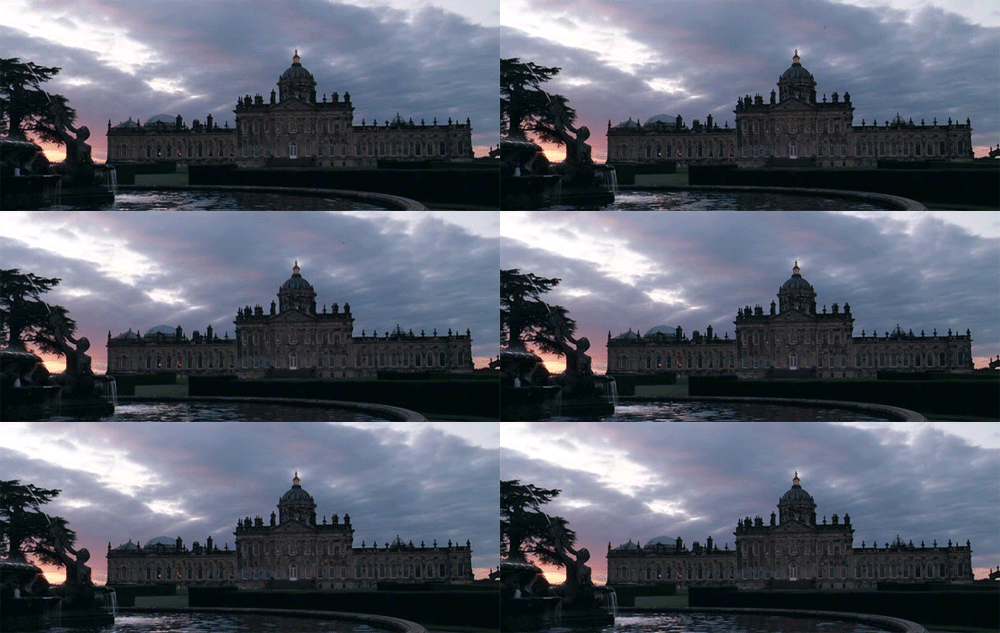
Castle Howard, North Yorkshire
served as the location for filming Brideshead
 in both the miniseries and the 2009 adaption.

Hello all! Hope you have been keeping up with the reading assignments. I'm hoping to post again soon about the title and the beginning of Book II. I absolutely loved the beginning of Book II -- I think that's my favorite literary part. Waugh is so eloquent! By the way, did you know  that Evelyn Waugh described this work as semi-autobiographical, recounting memories from his own years at Oxford? And, another quick fact: Waugh converted to Catholicism in the year 1930 after the failure of his first marriage. AND, don't you adore the place they used for the house? (In the words of Scott and Matthew, "That's MY house.")

Well, I recently posted on my other blog with some reflections on the book, so I thought I would repost it here for your enjoyment. It serves chiefly as an answer to the question as to why the book, in spite of its Catholic themes, has an appeal to such a broad audience.


Though Catholicism serves as one of the central themes of the story, it appeals to people of all beliefs (as evidenced by the fact that it is in top 100 lists of secular publications). For example, Waugh is one of the favorite authors of Fr. Robert Barron, a Catholic priest well known for his work in the "Catholicism" series, as well as the recently deceased British atheist, Christopher Hitchens. Why does a universal audience appreciate this novel when many non-Christians reject so many Christian stories? First of all, it is a well-crafted piece of literature! The writing style and the descriptions are beautiful, elegant, and poetic. Good art -- in this case, good writing -- appeals to a universal audience, regardless of background and belief. You can be a Budhist, an atheist, or a Catholic and still find the Sistine Chapel inspiring! In this case, we are dealing with literature not painting, but the truth still stands. As a quick example, I'm including a passage from the beginning of Book II:

"The human soul enjoys these rare, classic periods, but, apart from them, we are seldom single or unique; we keep company in this world with a hoard of abstractions and reflections and counterfeits of ourselves -- the sensual man, the economic man, the man of reason, the beast, the machine, and the sleep-walker, and heaven knows what besides, all in our own image, indistinguishable from ourselves to the outward eye. We get borne along, out of sight in the press, unresisting, till we get the chance to drop behind unnoticed, or dodge down a side street, pause, breathe freely and take our bearings, or to push ahead, outdistance our shadows, lead them a dance, so when at length they catch up with us, they look at one another askance, knowing we have a secret we shall never share."

Secondly the story itself is appealing to a broad audience with its high stakes and universal themes of love, friendship, betrayal, and spirituality. Thirdly, the view of Catholicism is coming from an outsider's perspective: Ryder is an agnostic raised without any religion. I think perhaps this may make the story more approachable for non-Christians. In addition, the portrayal of Catholicism is both enigmatic and controversial. I would hardly call it a favorable portrayal of Catholicism. Most of the characters who identify themselves as Catholic are seriously flawed. 
And yet, it is called one of the most Catholic novels of the 20th century. I have yet to understand why, but I am hoping it will become apparent by the novel's conclusion. 
We are currently nearly into Book II. I have also been watching BBC's miniseries adaption of the novel as I read. Though there have been a few unnecessary butt shots and there is a sex scene in need of skipping, the series is a commendable adaption of Waugh's masterpiece thus far! One of its greatest strengths is its faithfulness to Waugh's beautiful words. It also contains some excellent acting from Anthony Andrews and Jeremy Irons. If you are looking for some quality entertainment and food for thought before summer's end, I highly recommend Brideshead Revisited
And for all you soundtrack buffs, I've read reviews of the newer film that came out in 2008 and, while it's not as accurate and probably not as good, it does have a beautiful soundtrack! It's a similar style to the recent adaption of Pride and Prejudice and Finding Neverland.

Tuesday, July 3, 2012

Study Questions and Two Portraits

So I found a series of study questions from a previous reading of Brideshead Revisited, so I thought I'd share! I decided to do a bit of answering for question #3, specifically Charles and Sebastian. Almost to Book II, y'all!


1. Each character represents a prototype of certain attitudes towards religion. Understanding these roles helps us understand the tensions between the different characters. What type of person does each of the following characters represent? If any characters not on this list stood out to you then please share your thoughts.
--
A. Charles Ryder --   Charles, as an agnostic, offers a fresh perspective on Catholicism with which cradle-Catholics are unfamiliar. For most of the book he has acted as only an observer, a spectator on first the life of Sebastian and eventually on his whole family. He observes Sebastian's "Catholicism" or lack thereof, and the "Catholicism" of his family. The Catholicism of the Flyte family is particularly multifaceted with devotees and rebels, and Charles takes not of this.  He has merely observed for most of Book I. The most decisive act he has taken thus far was when he gave Sebastian a few pounds so he could slip off to the pub at the hunt during Christmas holiday. He was clearly disobeying the wishes of Lady Marchmain and siding with Sebastian, though I can't help feeling that until that point he was trying to play "nice" to both parties: Sebastian and his family. But it is here that he expresses his disapproval of Lady Marchmain's methods (and while I disagree with his method of disapproval, he's right in that Lady Marchmain's methods are clearly adding fuel to the fire rather than putting it out). I felt it keenly when he told Bridey that Sebastian may have had a chance at a happy, healthy life had it not been for religion. Perhaps this is true. The Catholicism which the Flyte family practices, with which Lady Marchmain has brought up her family, has certainly set up at least two of her children for disaster -- who knows what will become of Cordelia. Even Bridey himself doesn't seem entirely human to me, but I'll talk about him in a little bit. 


B. Sebastian -- Six words: "Make me virtuous but not yet." He believes in Catholic teachings "because they are a lovely idea." When Charles dismisses it as nonsense, Sebastian asks, " Is it nonsense? I wish it were. It sometimes sounds terribly sensible to me." (Which makes me wonder, is it a valid reason to believe something because it is a lovely idea? Unicorns are quite a lovely idea, but does that mean you can believe in it? Food for thought...) He believes, but he believes that one cannot be both Catholic and happy, which is positively dreadful, though I can see how people can arrive at such a conclusion. I wonder what his upbringing was like so that he came out in such a way? Such a tragedy. I still can't figure out why he was driven to drinking. His family, mostly his mother, obviously instigate it immensely, but I can't figure out why. Cordelia may hold a possible key. Just before Book II she tells Charles, "I used to thin Sebastian had [a vocation] and hated it--but I don't know now." He's obviously avoiding/running away from something, or perhaps many things.

C. Julia -- 

D. Lady Marchmain -- 

E. Lord Marchmain -- 

F. Rex Mottram -- 

G. Nanny Hawkins -- 

H. Cordelia --

I. Bridey --

2. While this book has certain themes that are undeniably Catholic, it appeals to people of all beliefs (the fact that it is on top 100 lists of secular publications is evidence for this). Why do you think a universal audience accepts and appreciates this novel when non-Christians reject so many Christian books, movies, etc.? What sets it apart?

3. Every single one of the characters displays virtues and major flaws, even the ones that are considered devout. Does the existence of major flaws in characters who identify themselves as Catholic enhance or detract from the overall impact of the book? Why?

4. Do you think that this novel presents an appealing view of Catholicism? Why or why not?

5. It would be a shame to read this book without noticing the beauty of Waugh’s writing, and drawing the connection between the beauty of his style and the message within. What sentence or paragraph most stood out to you as a snapshot of both Waugh’s skill as an artist and the tone or theme of the book?


Friday, June 29, 2012

Some Musings


Uh, hi. I exist.

I have enjoyed reading everyone's comments so far. Since we all represent different fields of study (philosophy, sacred music, computer science, literature), I’m going to stick to what I know which is writing. I know a bit about literature, but Marta knows more so I bow to her superior knowledge (incidentally she graduated summa cum laude so we should all flatter her a lot;)). My way of appreciating the beauty of Waugh’s work is by analyzing things like sentence structure.

I am totally in awe of Waugh’s command of language and have greatly enjoyed reading his work. The quintessential British bits, in particular, are very amusing. His descriptions are ridiculous and his vocabulary is immense. I don’t know how he can write in such long adjective laden sentences without losing me, but I love it. Waugh uses these bits to really immerse the reader in the setting. I think he used polysyndeton (excessive use of conjunctions) in the prologue to keep the pace sort of slow and monotonous like life in the army at the time.

In contrast, the dialogue is very sparse. Charles even mentions after one of his conversations with Lady Marchmain that the dialogue that has just been given is actually a condensed version of the actual conversation. Waugh also uses short sentences at various points in the narrative. I’m personally WAY too addicted to the use of short sentences (observe how I opened this post) but writers are only supposed to use them sparsely to give emphasis to whatever they are saying. Waugh uses this technique brilliantly.

I also don't find the interior monologue tiresome. My classmates in my fiction writing class last semester LOVED interior monologue and they drove me crazy. Amateurs can easily overuse this device in their attempts to sound realistic. Waugh uses interior monologue to connect the reader to Charles's thoughts and ideas (which will presumably be the most important in the novel), but he doesn't overdo it.

I'm weak on imagery, but I'm suspicious of the fountain at Brideshead. I have a feeling it has something to do with baptism. I could be making that up, but I read a lot of Raymond Carver last semester so forgive me. I haven't found Nate's avalanche yet (when did that pop up exactly?).

Hmm. I want to comment on the characters at some point, but I think I'll save that for another post. In the end, I think that writers' commentaries mainly involve gushing about how much they like some stuff and groaning about how much they hate other stuff. I guess that's basically what this post is.

Friday, June 15, 2012

What's in a Name?

"...That which we call a rose
By any other name would smell as sweet."
                - Shakespeare, Romeo and Juliet (II, ii, 1-2)

And so much for Shakespeare and roses...
What ho, what ho, what ho everyone!

Well, I had sort of an idea that I would burst onto this blogging scene with a long and clever post about any number of things. I even had some of what I would say planned out in my head. (my excuse for this: I'm an introvert) Then a thing called Time got right smack in the way and I couldn't seem to get around it. So, and to the relief of not a few readers, I feel sure, this post will be much shorter than originally planned.

Then too, after the contributions of Aunty Em and Marta, really, what is one to say? Thank you, Aunty and Marta. Though, as you both know, and the rest of you may come to realize, having nothing to say has never stopped me from saying it in the past and shall not, I think, do so any time soon.

You know, hang Time. This shall be a long post and I for one don't much care. I shall also mention that while I was thinking about what to say, I also thought of reasons why everyone would read a long post if I posted one. Read on, therefore, dear readers, and you shall see why you should read all this. First, I simply knew Teresa would read it. (if for no other reason than some weary sense of duty) (c.f. Captain Ryder in the Intro...) (PS you're great SO :) Emily, now, has always been kind to me and so she too, I knew, would read it. Marta is a very polite person and so I knew she'd read it, hoping I'd say something worthwhile by at least the last paragraph. I'm starting to hope so too. Nick, being a conscientious and forgiving man, ready to believe the best of anyone, would of course read it for those reasons. And Nathan, well, though I've met you but briefly I feel like some tenacious sense of curiosity may yet carry you through... 

Now we come to it. I have dubbed myself the resident Art Expert (having recently taken Art Appreciation) as well as the blog's Romance Columnist (having always taken an interest in what is now known colloquially as " 'shipping"). Not having any other sort of expertise, my contributions shall further consist merely of musings and affirming comments on other people's deep and clever posts.

Art: I don't actually know much about Art, and furthermore I thought Emily's post covered that topic rather well for the present.

Romance: At first I thought that Charles and Julia would never work out, but now that I consider the fact that she's the only eligible female character in the book so far... I'm on the fence on this one. No spoilers, please! For the moment I shall assume they will meet again and have at least some short fling, if not a more serious relationship. I can't say if they will marry- that is too far off.

Musings: I was thinking about the title of the work: "Brideshead Revisited". (hence my own title for this post) It appears to me that, judging from synopses I've read, Waugh may have intended more than one meaning for this. On the surface, Brideshead Revisited is about a dude who revisits a place called Brideshead, both in memory and in fact. All clear so far. BUT, I've read in synopses that this is a book about conversion and here's where it could get interesting. You see, Our Lord is the Head of his Bride, the Church. And so He too could be called "Brideshead". And now "Revisited" seems much more like another word for a conversion or reversion to faith, if you will. So perhaps, just perhaps, this was deliberate on Waugh's part and he chose his title to subtly present a major theme of the work. Or maybe I'm thinking too hard. Or maybe, I don't know, Jeffrey O'Shaunessy the literary critic said this in 1985 and it's all old news. But I just happened to think of it, so I thought I'd share.

Right then, off I go! I hope this post is at least half as fun to read as it was to write. I promise I'll try to keep them shorter in the future!

Pax, and a Blessed Feast of the Sacred Heart to you all!
-EM

Wednesday, June 13, 2012

"Et in Arcadia Ego"

So, first impression: this book is positively and inescapably British. The culture makes me rather dizzy trying to keep up with it all (FYI, a scout is a type of servant to a university student, which I guessed as much, but found out for sure today).
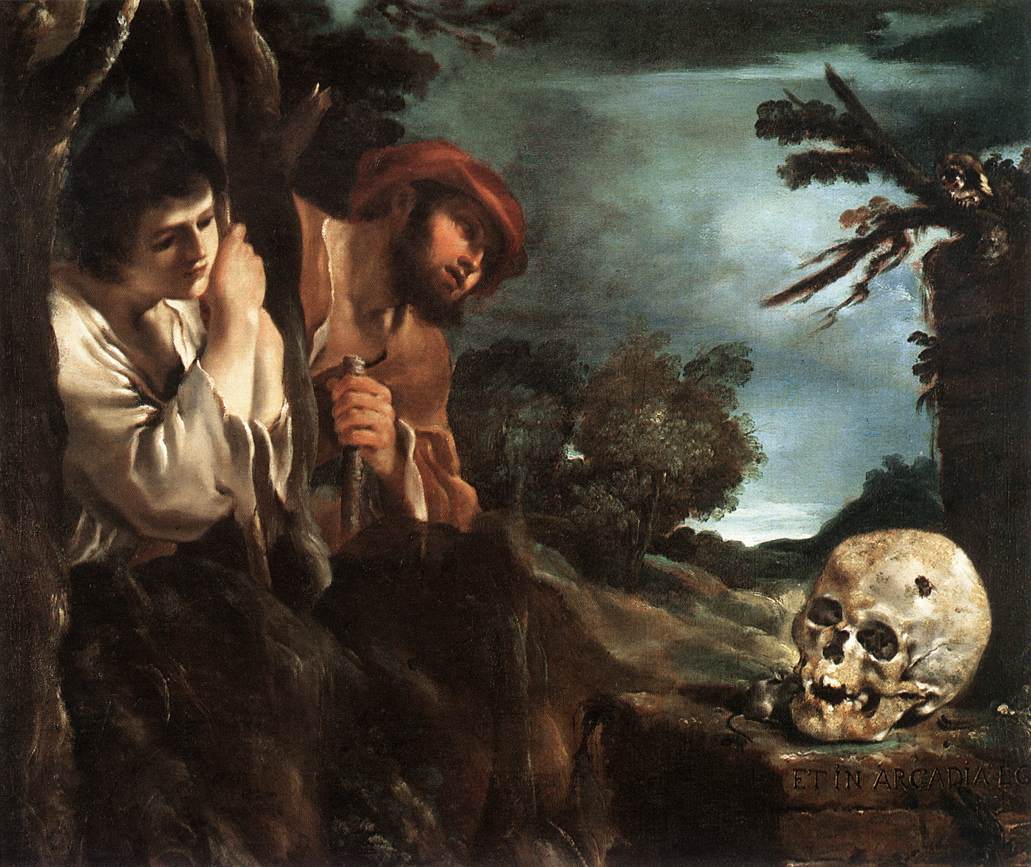
"Et in Arcadia Ego" by Guercino
One thing that particularly intrigued me was the title of Book I, "Et in Arcadia Ego." It's Latin (obviously), and it loosely translates, "I, too, am in Arcadia." The phrase turns up twice: first, as the title of Book I, and second, as a decoration of a human skull in Ryder's dorm room. This intrigued me, so I looked up the history of the phrase.

The phrase serves as the title of two separate paintings by Nicolas Poussin. Both are pastoral paintings depicting shepherds from classical antiquity standing alongside a tomb on which the phrase is inscribed.   In ancient Greece, Arcadians lived in the middle of the Peloponnese mountains as shepherds and apart from urban life.  Arcadia was viewed as a type of utopia which symbolized pure, idyllic life.  In Poussin's works, the person buried in the tomb seems to have lived in Arcadia and enjoyed the pleasures of life on earth but is now dead. The paintings may be interpreted as types of "Memento Mori" : Remember your death. There is an ironic contrast between the shadow of death and the typical merriment which the natives of Arcadia were believed to embody.
There is a third painting which also takes "Et in Arcadia Ego" as its title. This one is by the Italian Baroque artist Guercino and depicts two young shepherds looking at a skull, which is placed on a cippus bearing the same engraving as the work's title. This painting serves as the first appearance of the phrase in art and architecture.
The skull in Ryder's room seems to point more towards Guercino's painting.  Now, while I have heard of one or two people who had a skull decorating their dorm rooms at Franciscan, this does seem like an odd decoration. But then again, Ryder is also an artist so he's allowed to be eccentric. Regardless, both the title of Book I and the skull serve as ominous warnings, "Remember your death." Perhaps these point to further troubles to come? At the moment, Ryder and Sebastian seem blissful, enjoying each other's company and the many pleasures that life has to offer. Ryder is experiencing the childhood he never had, only with adult toys (drink and the like). They are in Arcadia, but it cannot last. Sebastian's home, Brideshead, also could be seen as a type of Arcadia with all of its beauty and grandeur.

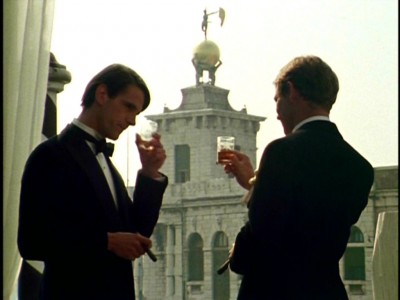
Sink me! It's Anthony Andrews!
Those are my observations thus far.  I must say the beginning has been rather confusing, but I've been gathering observations from much more intelligent sources than my musically inclined brain, such as a brief article from Fr. Robert Barron's "Word on Fire" blog (relax, there's no spoilers, in fact there's some good pointers to keep in mind). I also did some browsing on youtube (no, I didn't deliberately watch parts of the movie or the miniseries), and found a couple commentaries which I found most insightful.  But speaking of the BBC miniseries, it stars Anthony Andrews (of Scarlet Pimpernel fame in the Meixner and Wetzel households) as Sebastian (perfect!), and Jeremy Irons (Fr. Gabriel in The Mission) as Ryder. It looks like a fantastic adaption, though it calls for some discretion from the viewer. (I'd recommend reading the parent's guide on IMDB, they're usually very thorough in questionable content). The critic from decentfilms (he writes the film reviews for the National Catholic Register) didn't approve of the recent movie adaption of the novel, giving it a C-, so watch at your own risk.

Well, that's all for now! Keep up the reading and hope to hear from the other writers soon!

"Why Is This House Called a 'Castle'?": The First Summer at Brideshead

Hello fellow readers!

I'm only on Chapter Five right now, but I want to ask what you all think about Ryder's account of his first long stay at Brideshead. I was particularly drawn to his descriptions of the architecture and art of Brideshead. Maybe I've been neglectful as a reader, but didn't it seem to you that Brideshead Castle is difficult to visualize in the mind because of all the diverse styles and periods that its architecture and interior incorporate? The Marchmain family also reflects a diversity of personalities and spiritualities. I think it's important to note that Ryder is studying History at Oxford. Even though Ryder seems completely immersed with Sebastian in the present, Waugh seems to make a connection between Ryder's observations to a history that is rich and complex although it is obscure to him, and I don't think that history is limited to that of Sebastian's family. And I think it's also important to take into account that this part of the narrative is a flashback, in which Ryder is remembering his own history. I guess I could put it more simply by saying that maybe history is an important motif/theme. What is Waugh trying to show about the relationship an individual should have to history, whether it is personal or collective?

While I don't think this is the major theme in the novel (because, as O'Connor once sort-of said, it wouldn't be a very good novel if you could state the theme in one sentence) I just think this one important aspect to consider as we read.

A good friend once told me (actually, she told me quite often) that she has to think about something for three weeks before coming to any conclusions. I don't have any real conclusions about these observations. I was just curious what kind of thoughts/reflections these scenes might have evoked in you all.

Cheers!
Marta

Sunday, June 10, 2012

Preview of Coming Attractions...

Sorry folks, no time to chat now- gotta dash- but I thought I'd just give a hint about my post...

It has to do with Shakespeare and roses...

Pax, EM

Friday, June 8, 2012

Quomodo sedet...

Well, I've finished the book...I have a lot of free time. If you haven't gotten to it yet, the phrase "Quomodo sedet sola civitas" ("How the city sits alone!" referring to Jerusalem from the Book of Lamentations) turns up a great many times and in important places. I just want to make sure that you all have the proper music playing in your heads when you read it:

http://www.youtube.com/watch?v=B9BnqgvHCNw

Feel free to continue on after that verse...there are five more in this piece and I must say that it is worthwhile!

Also, could you remind me of the first place that the motif of an avalanche occurs? I know it did early on but I forgot where...

Thursday, May 31, 2012

"Turn left at the fork in the road..."

Right then everyone, some of us, including me, are a bit new to this whole blogging thing. Fortunately for me, all things technology love me and I love them. (though not as much as Teresa) (but I'll try to keep my sappyness to a minimum here. This is a public blog after all... Plus she may get embarassed. Aw, but she's so cute when she's embarassed... Augh, ok, I'll stop!)

The real reason I'm posting is not to struggle against saying sappy things to the s.o. but rather to give brief instructions to anyone who may not have my natural rapport with tech.

Signing in: When you go to the blog, you may need to sign in. You will know you need to sign in if you look at the top right corner of the blog and see the words "Sign In". If you see this, click it, and sign in. If you see the words "Sign Out" you're fine. Don't mess with it.

Posting: Apparently, the way to make a new post, like this one, is to again go to the top right corner, after you've signed in, and click on "New Post" or whatever it says there. I can't see it because I'm posting right now. Anyway, a screen should come up which looks postish. Post with it.

Responding to posts: The way I've found of responding to a post is to click on the post as it is displayed on the home page. Then you will be taken a page where there is a box under the post in which you may respond in.

Well I guess that's all for now! If you have any questions, please feel free to ask Emily. Oh, and thanks Aunty Em, for reposting your book club plan.

Cheers, bye! -EM 

Wednesday, May 30, 2012

Reading Schedule

Okay, folks! Here is the low down on the schedule for the reading of the Catholic novel of the 20th century, Brideshead Revisited, The Sacred and Profane Memories of Captain Charles Ryder. We will have weekly assignments starting each Sunday starting on June 3rd, meaning that you should have read the Prologue and Chapters 1 & 2 by June 10th, which is when the next assignment will be initiated. This blog is meant for posting comments and insights if something strikes you as you read it. After all, the whole point of reading this together is to promote dialogue!


June 3 : Prologue, Book I, Chapters 1 & 2 (page count: 55)

June 10 : Chapters 3 & 4 (42)

June 17 : Chapter 5 (44)

June 24 : Chapters 6 & 7 (52)

July 1 : Chapter 8 (22)

July 8 : Book II, Chapters 1 & 2 (51)

July 15 : Chapters 3 & 4 (35)

July 22 : Chapter 5 & Epilogue (46)